n Buenos Aires, Sunday lunch does not start at noon. It starts the moment someone pours charcoal into a metal trough and waits, without hurry。for the coals to turn white at the edges. That patience is the first lesson of Argentine barbecue: fire is a slow collaborator, never a tool to be rushed. A friend of mine in Villa Crespo keeps a notebook of asados — dates, cuts, guests, how long the embers rested before the first chorizo went on. He has filled thirty-one pages. Not one entry mentions a gas grill. Argentine barbecue happens on a parrilla, an iron grate tilted or cranked over the coals, and the person standing beside it, the asador, carries a quiet authority that has nothing to do with who owns the house. He decides when the fire is ready. Everyone else waits.
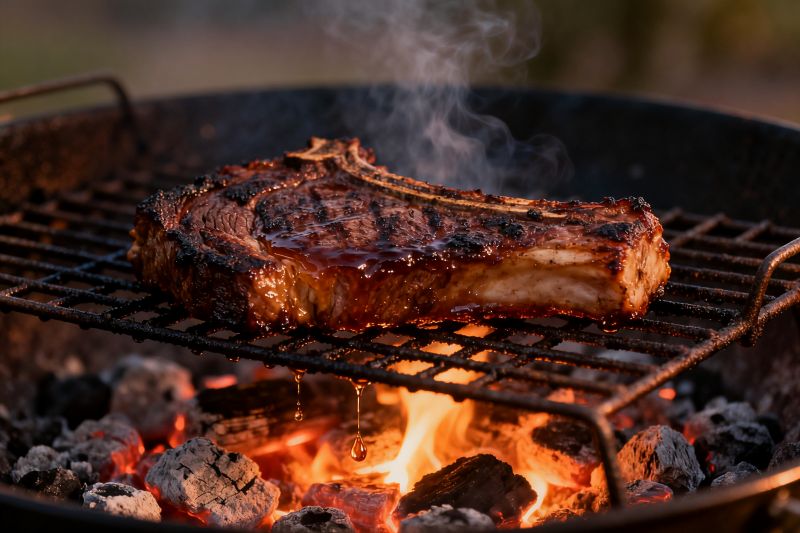
Start with the cuts, because Argentine barbecue has its own vocabulary, and none of it maps neatly onto a steakhouse menu. Tira de asado, a rack of short ribs cut crosswise, is the working-class backbone of the grill — cheap, forgiving, best eaten with your hands. Vacío, a fatty flank with a strip of membrane that has to cook slowly or turn chewy, is the purist's pick. Entraña, skirt steak, takes minutes and punishes distraction. Bife de chorizo, despite the name, is a sirloin, not a sausage, and it gets ordered by people who want a steak rather than a project. Before any of that, chorizo and morcilla land on the grate and are sliced open over a piece of bread so the juices stay off the plate. Provoleta, a thick disc of provolone pressed with oregano。shows up sizzling in a small iron pan while the meat still has twenty minutes to go. No part of Argentine barbecue is designed for speed.Salt, in most Argentine barbecue, means coarse salt and almost nothing else. I once watched an asador in Mendoza refuse a shaker of garlic powder with the face of a man being offered ketchup for a ribeye. Chimichurri is the one place where Argentine barbecue gets personal: parsley, garlic, vinegar, oil。dried oregano, sometimes a pinch of ají molido. It sits on the table, and using it well means using it sparingly. Some families spoon it over everything. Others treat it as an insult to good meat. Both positions get defended with total conviction, frequently at the same table, frequently by people who have been married for forty years. The regions differ too. In Patagonia, lamb is butterflied, staked around a ring of embers and left for hours;it tastes of smoke and salt and very little else. In the northwest, goat gets the same treatment. Empanadas come first, and in Tucumán they are small, dry and eaten with the fingers.Time is the real ingredient. A serious Argentine barbecue runs three to four hours before anyone eats anything substantial, and the eating is not really the point — the standing around is. This is the part visitors underestimate. Guests arrive early, get handed a glass of wine and a slice of chorizo, and drift toward the grill to offer advice nobody asked for. Children run between chairs. Someone always argues that the coals are too hot. When the meal finally starts it moves in waves: meat, salad, bread, more meat, a second round of chorizo that nobody planned. Then the plates get pushed aside and the sobremesa begins。
which can run longer than the cooking did. Fernet with Coke appears. Coffee appears. Nobody checks a clock. I have left tables at five in the afternoon and been asked, sincerely, why I was leaving so early.What strikes me after years of eating this way is how badly Argentine barbecue translates into a restaurant trend. It resists shortcuts at every step. The cuts are cheap and demand slow heat. The seasoning is close to nothing. The result depends on one person's attention across several hours, which is why a good asador gets treated with something near reverence, and why a family will cross the city on a Sunday for his cooking. Copying Argentine barbecue abroad usually means importing the equipment and missing the schedule — the long wait, the standing。the argument about the coals. It is not a dish. It is a timetable, a hierarchy and a debate that never quite ends. The meat, honestly, is sometimes the least interesting part.